Information about the work
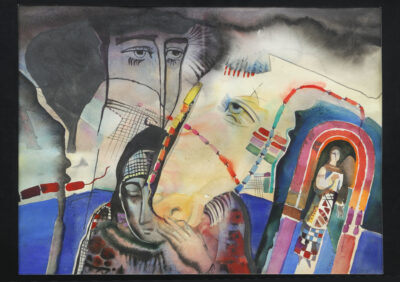
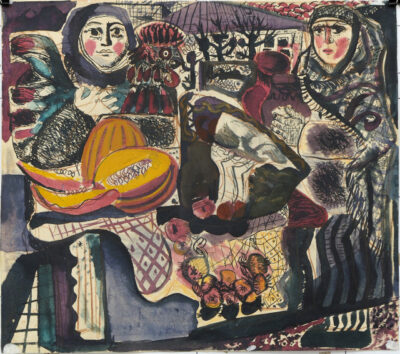
Mazur’s canvas Hardship [Skruta] (masonite, tempera, 1991, donated to the Khmelnytskyi Regional Art Museum collection by a private firm in 1993) is extremely emotionally intense and has a continuity with the ancient history and folk beliefs of Podilia. The canvas depicts one of the images frequently found in the artist’s works – a bird with a human figure inside. For the artist, a bird is not merely a creation of nature, because the inherently Slavic word “vyriy”, where birds fly away, held symbolic meaning for our ancestors. This is what they called the evergreen land in the sky or beyond the sea, where the gods and the souls of ancestors dwell, and where the soul of nature is preserved. Mazur often portrays a person inside a bird as a symbol of the soul flying away to the afterlife.
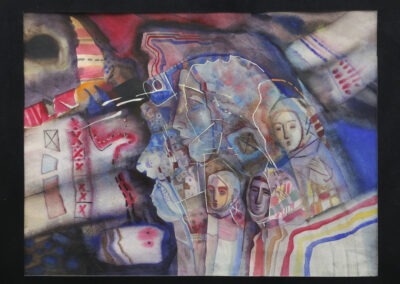
“The author consciously limits the color palette according to the mood of each work. Choosing a dominant color, he plays it out in nuances, tonalities, and coolness, and uses supplementary contrasting colors to accentuate its resonance. For example, the canvas ‘Hardship’, where the main spot – the compositional center – is painted in gradations of red, the background is grayish-blue, and red and blue are combined through the addition of whites and achromatic grays, which enriches the palette and creates harmony among contrasts. Here, as in every work, there is a dominant color; it is complicated by nuances, diversified tonally or by textures, and this gives depth to its resonance. […] The paint spreads across the canvas and forms a graphic structure, ceases to be dominant, and is used as an additional means of expressiveness.” (Oksana Mazur).
One of the new compositional techniques invented by the artist in the late 1980s is the creation of a general silhouette or main color spot into which he densely fits the main elements of the image. Such an approach to compositional construction not only forms an integral image but also emphasizes the idea of the interconnection of people, things, events, spaces, and times.
A meticulous analysis of compositional and coloristic techniques and the elaboration of the imagery led to the invention of a personal artistic language through which the artist transmits his own and societal states of that time. With a dramatic palette built on contrasts and a syncretic figurative system, the author eloquently speaks about tragic events that must be remembered, yet changing or turning back time is impossible. Among such global tragedies of the Ukrainian people are wars, Holodomors, repressions, and the Chornobyl disaster. The synthesis of images and meanings (when, in addition to the main motif, the artist uses several more meaningful lines on the canvas) makes it possible to expand the boundaries of both interpretation and historical context.
Hardboard, tempera. 101 × 100