Biography
Oleh Terentiyovych Minko (1938, Makiivka, Donetsk region – 2013, Lviv) was a painter, monumental artist, and educator. Father of the artist Iryna Minko-Murashchyk.
From 1962 – Participant in art exhibitions.
1965 – Graduated from the Lviv Institute of Applied and Decorative Arts, studying under Karlo Zvirynskyi.
1970 – Member of the National Union of Artists of Ukraine.
From 1982 – Taught at the Lviv Institute of Applied and Decorative Arts: 1990–1993 served as Dean of the Faculty of Artistic Weaving; from 1991, Professor and Head of the Department of Artistic Textiles.
2009 – People’s Artist of Ukraine.
Lived and worked in Lviv.
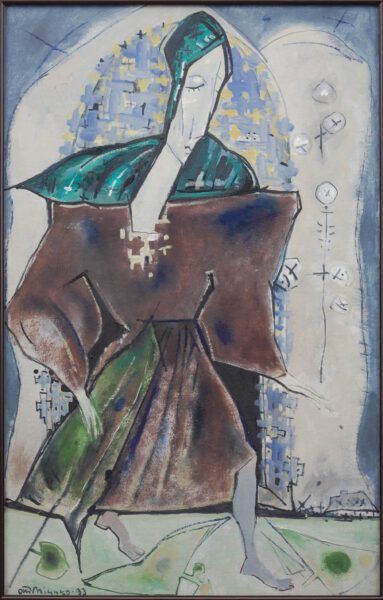
“The oeuvre of the Ukrainian postmodernist artist Oleh Minko completely dispels the myth of the total ‘Socialist Realism’ of Soviet-era Ukrainian painting. Art historians consider Minko—who synthesized Expressionism with Ukrainian traditionalism—a key figure for understanding contemporary art. The prominent Karlo Zvirynskyi acknowledged: ‘To me, Minko is a unique artist. No one in Galicia painted like him, nor have I seen anything similar in world art,'” writes Svitlana Yeremenko, author of Painting as Prayer.
Oleh Minko’s classmate, People’s Artist of Ukraine Ivan Marchuk, recalled: “Oleh stood out markedly among the students. He was so distinct, and his formal experiments were so unusual, that we were left bewildered, not knowing how to process it all.” Students seeking creative freedom studied the achievements of Ukrainian and world art, searched for new expressive means, staged “apartment exhibitions,” shared their breakthroughs, and discussed the latest trends in European art. When this reached the security services, KGB interrogations began. This ordeal deeply impacted Minko’s psychological state, silencing him for six years. The artist returned to creative work in the late 1980s amid the socio-political transformations sweeping Ukraine.
“Oleh Minko’s macrocosm is a system of signs and figures forming distinct compositional narratives designed to preserve and transmit specific information to contemporaries. Operating with pure form dictated by a sign function, the artist actively combines cosmogonic symbols (crosses, circles, rhombuses, dots) with zoomorphic (birds, beasts) and anthropomorphic elements in his compositions, restoring their original primal meaning.
Behind this multifaceted figurative symbolism lies no mere decorativeness—which degrades symbols into meaningless clichés and breaks their feedback loops—but rather a profound emotional content and a true human self-perception. In Minko’s works, these symbols operate as modern interpretive information codes. Furthermore, a regenerative function revealing the internal structure of the symbol reflects the artist’s rich spiritual world, unveiling facets of a talent and creative gift that remain yet to be fully comprehended.
The symbolic order of Minko’s canvases is a synthesis of the sensory and the supersensory, a unity of imagination and intellect. In place of a plot-driven, representational concept, he proposes a new understanding of art’s formal values. By objectifying archetypal consciousness within an ethnic and national framework through connections with past individual experience, Oleh Minko enabled the expression of non-rational constants of worldview, revealing the authentic context of the national visual tradition,” writes art historian Liliya Shpyralo-Zopotochna.